#5- Research Initiatives- Sami Ford
Weaving and Knits:
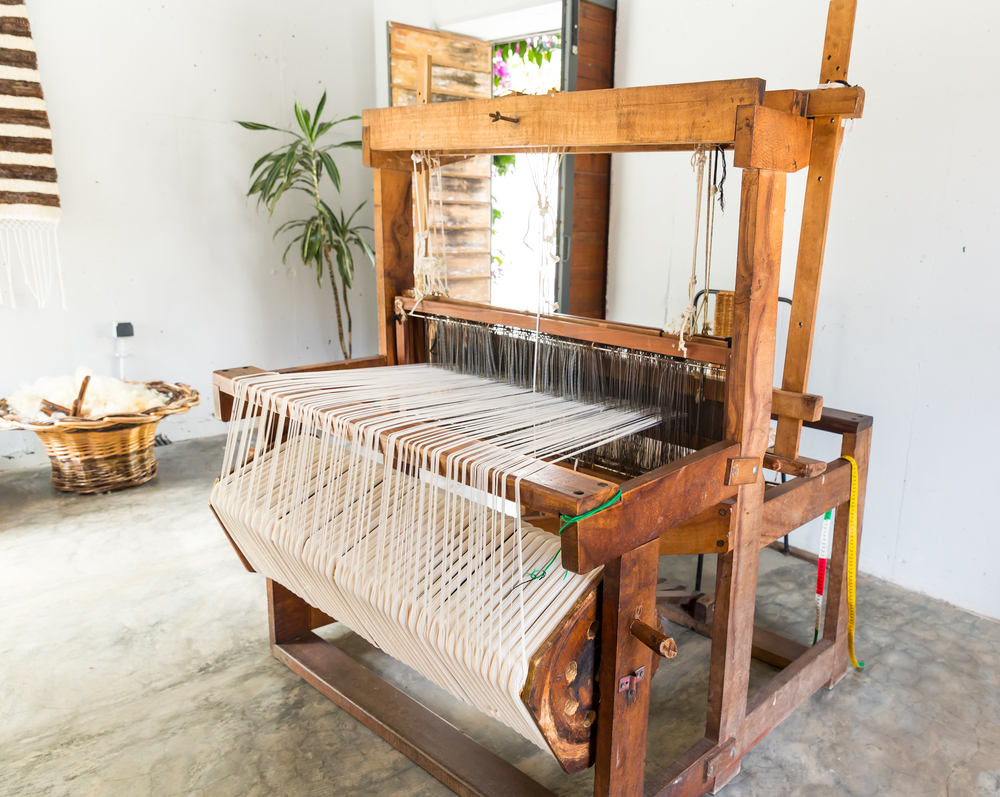
Weaving has been around since the early Stone Age, and yet the basic concept stays the same. Now with the use of technological machines the speed and sophistication have improved immensely. To accomplish basic weaving, you need two sets of threads, which are called the weft and the warp. The warp is two rows stretched lengthwise, the weft goes back and forth between the warps. There are many different parts of a weaving machine to create the perfect weave. The reed pushes threads together to keep it from unraveling. Heddles provide control for the machine to keep the threads organized. Each heddle has an eye, that threads the warps. Heddles are suspended on shafts moves up and down to move the threads. Older machines use a shuttle, which is a spool of thread that unravels, it is moved manually back and forth and is very time-consuming. Now a days, a shuttle is replaced by a rapier, which passes threads back and forth. Industrial looms are extremely fast, the shaft moving a thousand times per minute.
Patterns are created using different types of thread, a weft presenter selects colors from different bobbins, giving them to the rapiers. More complex patterns use a jacquard attachment, which controls all the threads loaded into the machine, allowing ornate designs to be formed.
Denim Manufacturing
When producing denim, they used something called a tension or whip roll to maintain constant tension on the warp yarns. These yarns then go through drop wires, which will stop the loom if something goes wrong. They also have heddles, which have eyes that are within a harness. Next the yarns proceed through the dents of the reed, which is a comb-like device to maintain spacing, and beats up the weft yarn into the body of the cloth at the fell of the cloth. This point transitions into fabric and winds over the takeup roll, sand roll, or press roll.
Twill Weaving
A twill fabric or weave is characterized by the diagonal lines on the face of a cloth. This is formed by the floating or rising of warp yarns over the weft yarns. The twill line is determined by the direction of the diagonal. If the twill line moves from the lower left to the upper right, the twill is a right-hand twill, or a Z twill, from the opposite direction is an S twill. A normal twill is 45 degrees, if it is higher, it is called steep, and a lower degree is referred to as a reclining twill. Warp risers and sinkers determine the pattern. The yarn twist can determine the twill line and ridge height. Herring bone weaves are broken twill weaves composed of alternating left- and right-hand twills.
Jacquard Weaving
A jacquard loom allows for more intricate patterns. Once the design is created it needs to be translated into punch cards. The cards are then stitched together into a continuous belt and then fed into the loom. The holes in the cards control which threads are raised for weaving the pattern. Automation enabled by the Jacquard loom allows design to be produced cheaper, allowing intricate patterns to become more common. Of course, this process is more computerized today, but it is still the same overall concept.
Knitting
Knitting is defined as the intermission of yarn into loops to form fabric. In knitting there are basically two systems, weft and warp. Weft knitting is accomplished by loops formed in a horizontal manner by adjacent needles. A circular knitting machine creates tubes of fabric in a spiral configuration around a cylinder. The width of the fabric is determined by the number of needles on the machine. A flatbed machine creates weft yarns. Needles placed next to each other one knit after another, producing one row of loops from the same yarn. The yarn is measured by courses and wales, which are the amount of horizontal and vertical number of loops. A warp knitting machine is similar to that of a weaving loom.

Fire
Fibers in fabrics can be identified by burning.
Cotton and Flax are natural cellulosic fibers, they burn but do not melt, smell like burning wood or paper, and have a fine gray ash residue.
Wool and silk are natural protein fiber, they burn but do not melt, smell strongly of burning hair or feathers, it stops burning when it is removed from fire, and its residues are like black hollow beads that can be crushed to black powder. Silk does not have as strong an odor because it does not contain sulphur.
Rayon yet has the same reactions as natural cellulosic fiber; it is an artificial cellulosic fiber, it burns but does not melt, smells like burning paper or wood, and has fine gray ash residue.
Polyester on the other hand is an artificial fiber that shrinks from heat, melts, burns, and drips, smells like sweet chemicals, and its residues are a hard cream or black colored bead that cannot be crushed. Nylon is very similar, except it does not drip and can smell like celery.
Acrylic is also an artificial fiber. It shrinks from heat, melts and burns, can sputter when burning, has an acrid smell, and residues are a hard cream or black colored bead that can be partially crushed.
Acetate is an artificial fiber that shrinks from heat, melts and burns, smells like burning cellulosic fibers) of burning wood or paper), but with a bit of vinegar, and residues are a hard cream or black colored bead that can be partially crushed.
Tensile Strength Testing
Tensile Strength testing determines the strength and elongation of a fabric. Basically, what occurs during this test is that a machine pulls fabric apart, using a certain amount of force to see how long it can extend. It tests the strength of fabric.
Abrasion Testing
Abrasion testing is when the material is rubbed at a specific weight and speed in order to determine how many rubs it material can take before it wears out. Pill testing determines the resistance of a fabric to see how easily it forms pills on the surface of a fabric.


Comments
Post a Comment